
Blog
Signs It's Time to Redesign Your Website
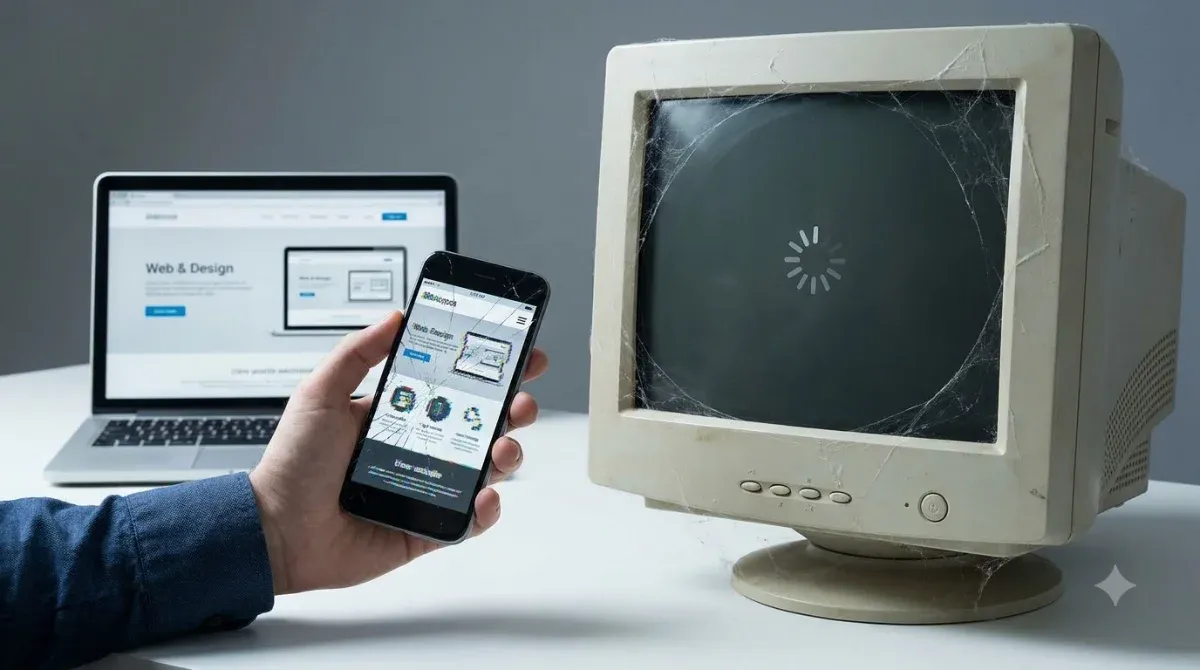
Most business owners do not redesign their website too early. They redesign it years too late, usually after months of blaming the ads, the season, or the market for numbers that a tired website was quietly dragging down the whole time. A site does not fail loudly. It fails slowly, one bounced visitor and one abandoned form at a time, and by the time the problem is obvious in the revenue, it has already cost you far more than the fix would have.
The hard part is that your website looks fine to you. You built it, you know where everything is, and you visit it on the same laptop every day. Your customers do not. They land on it cold, on a phone, comparing you against three competitors in the same ten minutes, and they decide in seconds whether you look like a business worth trusting.
So the useful question is not “do I like my website.” It is “is my website costing me customers I never hear about.” The signs below are the ones that answer that.
What are the signs it’s time to redesign your website?
It is time to redesign your website when it is hard to use on a phone, slow to load, visually dated, difficult to update, or no longer generating leads. Any one of these hurts results. Two or more together usually means a redesign will pay for itself faster than any other marketing spend you are considering.
Here are the signals that matter most, in rough order of how much damage they do:
- It struggles on mobile. If you have to pinch, zoom, or scroll sideways to read your own site on your phone, so does every customer. Most of your traffic is mobile now, so a site that only works well on a desktop is a site that fails most of the people who see it.
- It loads slowly. A page that takes several seconds to appear loses a large share of visitors before they see a single word. Speed is not a nice-to-have. It is the price of entry, and Google treats it as a ranking factor through Core Web Vitals.
- It looks dated. Design trends move, and a site that looked modern five years ago now signals “this business stopped paying attention.” Customers read a dated site as a dated company, fairly or not.
- You cannot update it yourself. If changing a phone number or adding a service means emailing a developer and waiting a week, your site is a liability. You will avoid updating it, and it will drift further out of date.
- It gets traffic but no leads. Visitors arrive and leave without calling, filling a form, or buying. That is not a marketing problem. That is a website that is not built to convert.
None of these are cosmetic complaints. Each one maps directly to lost enquiries, and they compound. A slow site that also looks dated and hides its contact button is not three small problems. It is one large one.
How do you know if your website is outdated?
A website is outdated when its design, technology, or content no longer matches how customers behave and what competitors offer. The clearest tests are simple: open it on your phone, time how long it takes to load, and ask someone outside your business what it makes them think. Their honest reaction is your answer.
Owners are the worst judges of their own site because they are too close to it. You know your business is good, so you read that quality into a website that does not actually communicate it. New visitors have none of that context. They only have what is on the screen.
A few grounded checks cut through the bias. Watch a friend or customer use your site for the first time without helping them, and note every moment they hesitate, squint, or go back. Compare your homepage side by side with your two strongest competitors and be honest about who looks more credible. Check whether the site still reflects what you actually sell, or whether it lists services you dropped and misses ones you now lead with. The Nielsen Norman Group’s analysis of how often homepages are redesigned found the average homepage changes about 40 percent a year, which works out to a full redesign roughly every three years. That is the rhythm the web moves at, and a site that sits still through it visibly falls behind.
If the site fails those checks, it is outdated in the way that matters. Not because it offends your taste, but because it is losing you work.
What is a dated website actually costing you?
A dated website costs you in three ways at once: lost visitors who leave before converting, lower search rankings that shrink how many people find you, and weaker trust that makes the visitors you do keep less likely to buy. These losses are invisible on a bill, which is exactly why they run for so long unchecked.
The table below maps the common signs to what each one is quietly costing, and what a redesign changes.
| Warning Sign | What It Costs You | What A Redesign Fixes |
|---|---|---|
| Poor on mobile | Most visitors leave immediately | A layout that works on any screen |
| Slow to load | Visitors and search rankings both drop | Faster pages that hold attention and rank |
| Dated design | Lower trust, fewer enquiries | A modern look that signals credibility |
| Hard to update | Stale content, avoided changes | A site you can edit without a developer |
| Traffic but no leads | Wasted marketing spend | A structure built to convert visitors |
The pattern to notice is that these problems do not stay in their lane. A slow, dated site also ranks worse, which means fewer people find it, which means the poor conversion is happening to a smaller audience too. That is how a website problem masquerades as a marketing problem for years.
Should you redesign or just tweak your existing site?
You should make small tweaks when the foundation is sound and only the surface feels tired, and commit to a full redesign when the problems are structural: broken on mobile, slow at its core, or impossible to update. Patching a fundamentally flawed site costs more over time than rebuilding it properly once.
Not every problem needs a redesign. If your site is fast, mobile-friendly, and easy to update, but simply looks a little dated, a refresh of the visuals and copy may be enough. That is the cheaper, faster path, and there is no sense rebuilding what already works.
The calculation changes when the problems are baked into the foundation. A site built on old technology that cannot be made fast, or one whose structure fights every attempt to update it, will keep costing you in patches and workarounds. At that point, repeated fixes are the expensive option, not the safe one. This is where understanding the real cost of a website redesign helps you weigh a one-time investment against the slow, ongoing drain of a site that no longer earns its place.
How to decide if a redesign is worth it
Beyond spotting the signs, a sound decision comes down to what the site is supposed to earn. Start with the job, not the look. Write down what you actually need the website to do: bring in enquiries, sell products, book appointments, or establish enough credibility that a referral turns into a call. Then judge the current site honestly against that list. A website that looks acceptable but does not do its job is failing, however pleasant it is to look at.
Next, put a rough number on the cost of doing nothing. If your site converts even a few percent worse than it should, work out what that means over a year in lost enquiries, then in lost revenue. That figure is almost always larger than owners expect, and it is the true benchmark a redesign has to beat. Set against a slow leak that runs every month, a one-time rebuild usually looks less like a cost and more like plugging a hole.
Finally, treat the redesign as a business decision with a measurable return, not a vanity project. Decide up front how you will know it worked: more enquiries, a higher share of visitors who take action, better rankings for the terms that bring buyers. If the thing holding you back is the fear of losing the rankings you already have, how to redesign a website without losing SEO is the runbook that removes that risk.
If you are ready to fix the signs above, our website design and development services are built to turn a site that quietly loses customers into one that earns them. If you are in Bengaluru, we work with Bangalore businesses directly.
Frequently Asked Questions
How often should a business redesign its website?
There is no fixed rule, but most businesses benefit from a significant redesign every three to five years, because design standards, technology, and customer expectations all move within that window. The better trigger than a calendar is performance: if the site is slow, weak on mobile, or no longer generating leads, it is due regardless of its age.
Can I redesign my website without losing my Google rankings?
Yes, if it is done carefully. Rankings are put at risk by careless redesigns that change or drop URLs without proper redirects, remove content that was ranking, or slow the site down. A well-planned redesign preserves your existing content and link structure, sets up redirects correctly, and usually improves rankings by making the site faster and easier to use.
Is a slow website really enough reason to redesign?
Often, yes. Speed affects both how many visitors stay and how well you rank in search. If a site is slow because of outdated underlying technology that cannot be meaningfully fixed, that alone can justify a rebuild, since almost every other improvement is undermined by a page that visitors abandon before it loads.
What is the difference between a website refresh and a full redesign?
A refresh updates the surface, such as colours, fonts, images, and copy, while keeping the existing structure and technology. A full redesign rebuilds the site’s foundation, layout, and often its technology. Choose a refresh when the site works well but looks tired, and a full redesign when the problems are structural rather than cosmetic.
How do I know if my website is losing me customers?
The clearest sign is traffic that does not convert: people arrive but few call, enquire, or buy. Combine that with a high number of visitors who leave almost immediately, poor performance on mobile, and slow load times, and you have a site that is actively costing you enquiries you never hear about.
Sources: