
Blog
A Complete Guide To SEO For Your Small Business Website
What does SEO for a small business actually involve?
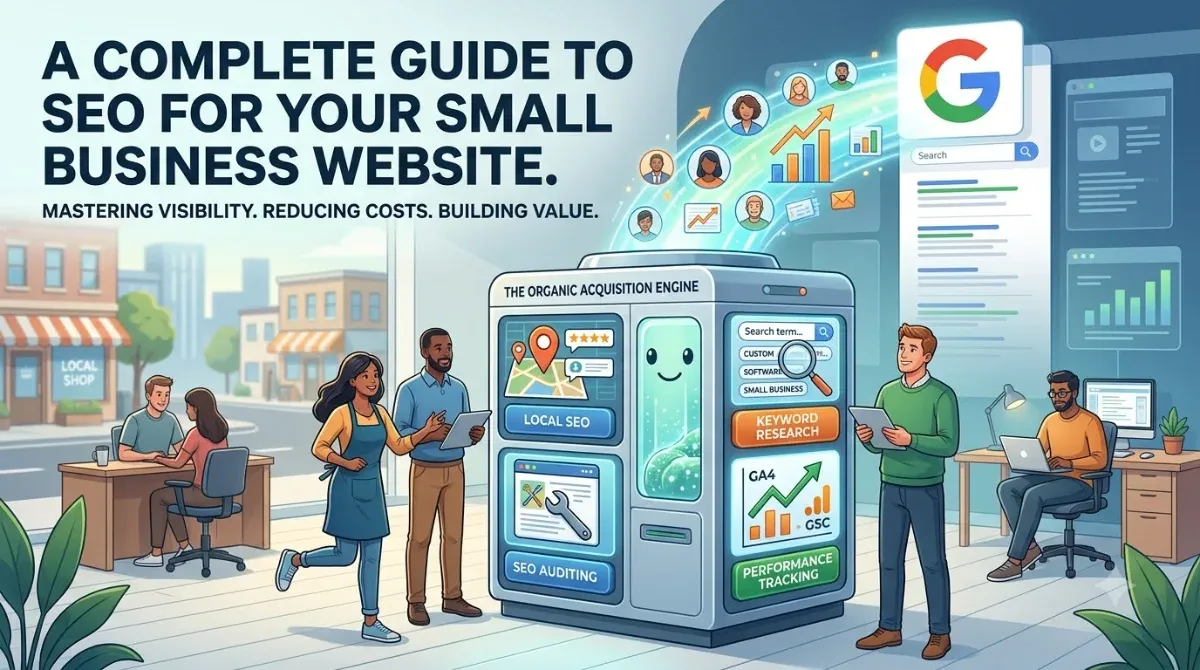
SEO for a small business breaks down into five jobs: get found in local searches, target the keywords your buyers actually type, audit your site so search engines can read it, track the metrics that tie to revenue, and give it time to compound. It’s not a trick or a one-off. It’s a routine, and most of the early wins are things you can do yourself for free.
Organic search is still one of the biggest sources of qualified traffic a small business can get, and unlike ads, it doesn’t switch off the moment you stop paying. That’s the whole appeal: money spent on rankings keeps working. If you want the simplest mental model first, start with the 3 C’s of SEO: content, code and credibility.
The catch is time. Across the major guides, the honest number keeps showing up: expect at least six months before you see real movement, often closer to a year. SEO compounds, but slowly at first. If someone promises you page one in a month, they’re either lying or about to get your site penalized.
Let’s walk through the five jobs.
What are the best local SEO strategies?
The core of local SEO is claiming your Google Business Profile, keeping your name, address, and phone number identical everywhere they appear, and steadily collecting genuine reviews. Local search ranks you on proximity, relevance, and prominence, and those three levers move all of them.
Start with your Google Business Profile. Claim it, verify it, fill in every field. This is the single highest-leverage thing a local business can do, and it’s free.
Then get obsessive about your NAP: name, address, phone number. Make them match exactly across your website footer, your Google profile, Yelp, and every directory you’re listed in. “Street” in one place and “St.” in another sounds trivial, but inconsistent NAP data genuinely confuses crawlers and drags your local ranking down. Pick one format and make everything match it.
If you serve several towns, build a real page for each one, not the same paragraph with the town name swapped in. Google spots duplicated pages instantly. Put actual local detail on each: a nearby landmark, a project you did there, a customer from that area.
And ask for reviews, consistently. Review velocity (how steadily new ones come in) and sentiment both feed the local pack rankings, the map results that sit above the regular links. If reviews are central to how you’re found, our guide to online reputation management for local search goes deeper on protecting your brand across directories.
How do you do keyword research for a small business?
Keyword research is figuring out the exact phrases your buyers type, then judging each one on search volume, buying intent, and how hard it is to rank for. The winning move for a small business is going after long-tail phrases: longer, more specific searches with less competition and far more intent to buy.
Start with your services, then write down the words real customers use for them, not your internal jargon. Nobody searches “integrated dental care solutions.” They search “emergency dentist near me.” Google Keyword Planner is free and shows you search volume and cost-per-click, and a high CPC is a useful tell: advertisers only pay a lot for a term when it converts.
Then go narrow on purpose. Ranking for “software development” is hopeless for a small firm; every giant on earth is fighting for it. But “custom inventory software for small manufacturers” is winnable, and the person typing it is close to signing a contract. That’s the trade you want: less volume, far more intent.
Group your keywords into themed clusters, and give each page one clear target. One page trying to rank for six unrelated terms ranks for none.
Here’s how the five jobs compare at a glance:
| Job | What it’s for | Free tool to start | How often |
|---|---|---|---|
| Local SEO | Map-pack visibility, nearby customers | Google Business Profile | Weekly |
| Keyword research | Finding what buyers search | Google Keyword Planner | Monthly |
| Technical audit | Making the site crawlable and fast | Google Search Console | Quarterly |
| Performance tracking | Tying traffic to revenue | Google Analytics 4 | Ongoing |
| Patience | Letting it compound | (none, just time) | Months |
Which tools are best for a small business SEO audit?
The free starting point is Google Search Console for indexing and Core Web Vitals problems. Add a crawler like Screaming Frog to catch broken links and duplicate tags, and a domain tool like Moz or Ahrefs to see your backlinks. You don’t need all of them on day one.
An audit exists to find the technical stuff quietly stopping search engines from reading your pages. Begin with Google Search Console, it’s your direct line to how Google actually sees your site. It flags indexing errors, Core Web Vitals problems, and any manual penalties, and it costs nothing.
When you want to go deeper, run a crawler like Screaming Frog across your site. It surfaces the unglamorous problems that silently cost rankings: broken internal links, missing meta descriptions, redirect chains, two pages fighting over the same H1. Then a domain tool like Moz or Ahrefs shows who’s linking to you and how your authority stacks up against competitors.
Your structured data shows up in an audit too, so validate your schema markup every time. A broken schema block is easy to miss and costs you rich results.
Which SEO metrics actually matter?
The metrics worth tracking are organic traffic, keyword rankings, click-through rate from search results, and, above all, organic conversions. Rankings feel good, but traffic and conversions are what pay the bills. Don’t celebrate a number that doesn’t show up in revenue.
It’s easy to get high on vanity metrics. A keyword climbing from position 15 to 8 is satisfying, but if nobody clicks and nobody buys, it changed nothing. Use Google Analytics 4 to watch organic sessions, engagement time, and completed goals: form fills, calls, bookings.
Then watch your click-through rate in Search Console for your top queries. When a page gets loads of impressions but few clicks, that’s a specific, fixable problem: your title tag and meta description aren’t compelling enough to win the click. Rewriting those two lines can lift traffic immediately, no new content required. It’s the closest thing to a free win in SEO.
How do you measure SEO ROI?
You measure SEO ROI by tracing organic traffic all the way to money: which form fills, calls, and sales started as a search. Assign a value to each conversion, subtract what you spent on SEO, and the rest is your return. Because rankings compound, that return usually grows fastest in years two and three.
First, put a number on your conversions. What’s a booked consultation worth to you? A lead form? Even a rough figure beats none. Then add up your SEO costs: any tools, content, or agency fees. Subtract cost from the revenue organic search brought in, divide by the cost, multiply by 100. That’s your percentage return.
The pattern to understand is the compounding. Paid ads stop the instant your budget does. Organic rankings do the opposite: they build on themselves, so a page you published in year one keeps pulling in leads in year three at no extra cost. That’s slow to start and hard to be patient with, but it’s exactly why SEO tends to beat paid over any real time horizon.
If your customers are local, the fastest returns usually come from local search rather than national terms. That is the work we do for Bangalore businesses.
Frequently Asked Questions
What’s the difference between on-page and off-page SEO?
On-page SEO is everything you control on your own site: keywords, title tags, page speed, content quality. Off-page SEO is the trust you build elsewhere, mainly backlinks from reputable sites, reviews, and brand mentions. Both sit inside the broader four types of SEO every small business should know.
How long does small business SEO take to work?
Usually six to twelve months of consistent work before you see substantial, compounding growth. SEO is cumulative, early effort on technical fixes, content, and authority pays off later rather than immediately, so treat the first six months as building, not measuring.
Does a small business really need a blog for SEO?
A blog is one of the best ways to target long-tail keywords and answer the specific questions your customers search for. Without one, your site is mostly limited to ranking for your homepage and service pages, which caps how many searches you can ever show up for.
Can I do SEO myself or should I hire an agency?
You can absolutely handle the fundamentals yourself with free tools like Google Search Console and Keyword Planner if you’ve got the time to learn. Agencies earn their keep later, when technical audits, link building, and advanced schema get too involved to do well on the side.
Does posting on social media help SEO?
Social shares aren’t a direct ranking factor. But active social profiles get your content discovered, drive traffic, and build the brand awareness that indirectly supports your search presence, so it helps, just not in the way people assume.
Sources: