
Blog
What Are The 4 Types Of SEO?
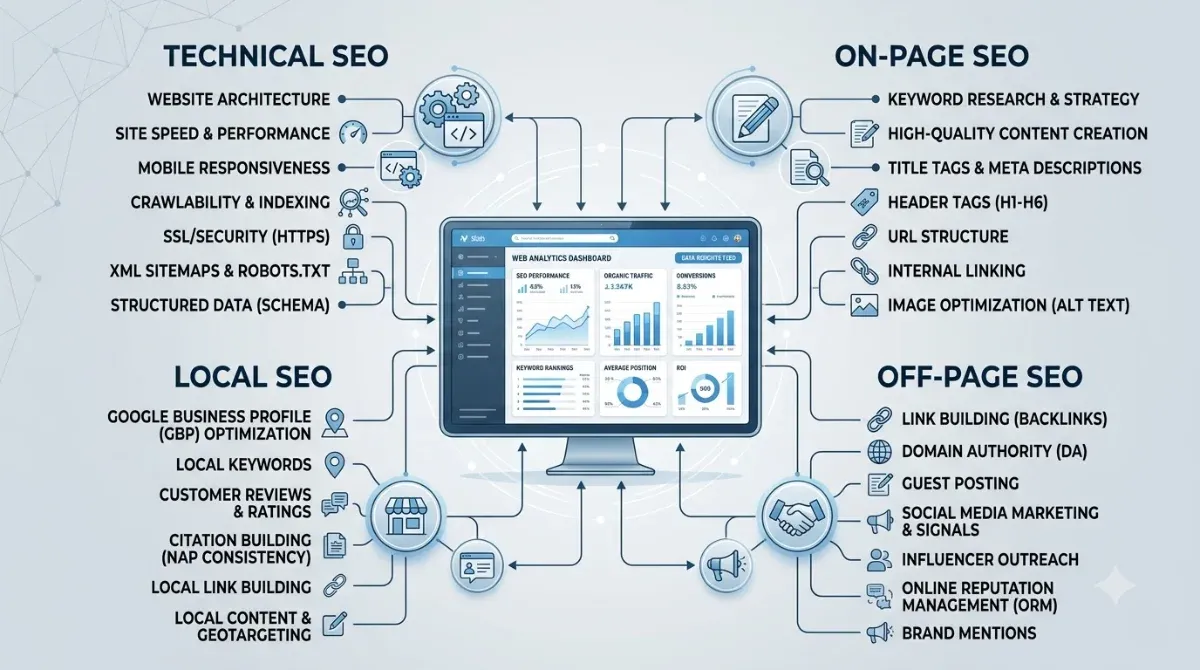
Search engine optimization is no longer a monolith defined simply by keyword stuffing and directory submissions. Modern search engines evaluate websites through complex rendering engines, semantic intent classifiers, and machine learning models. To capture qualified B2B traffic, digital strategists must segment their workflows across distinct operational pillars.
Understanding these foundational pillars helps technical marketers allocate resources efficiently, secure crawl paths, and build structural authority that survives algorithmic volatility. For a simpler three-part version of the same framework, see what the 3 C’s of SEO are.
What are the 4 types of SEO?
The four primary types of search engine optimization are technical SEO, on-page SEO, off-page SEO, and local SEO, each targeting a different layer of search algorithms to secure site infrastructure and maximize organic visibility.
Each discipline addresses a distinct vulnerability in how search engines discover, crawl, render, and rank web properties. Neglecting any single pillar creates a structural bottleneck that suppresses organic performance across the entire domain.
1. Technical SEO and Infrastructure Optimization
Technical SEO governs the underlying architecture of a web property. It ensures that search engine crawlers can access, parse, index, and render site pages without encountering server errors, blocked scripts, or infinite redirect loops. In complex B2B environments, technical debt often accumulates rapidly through poorly structured JavaScript frameworks, misconfigured canonical tags, and bloated codebases.
Core technical optimizations focus on reducing time to first byte (TTFB), passing Core Web Vitals thresholds, and maintaining a clean XML sitemap. Search engine crawlers operate on constrained crawl budgets. If a bot spends its allocated time parsing low-value filter parameters or broken pagination links, critical revenue-generating product and service pages may remain unindexed.
Advanced practitioners also implement structured data markup using schema.org vocabularies. This explicit semantic markup helps search engines categorize organizational entities, product specifications, and author credentials, directly influencing how rich snippets appear in search result pages.
2. On-Page SEO and Content Relevance
On-page SEO involves the meticulous optimization of individual web pages to match user search intent and communicate topical depth to search engine parsers. This goes far beyond placing a primary keyword into a title tag. Modern on-page optimization requires structuring content around semantic entities, addressing latent semantic indexing (LSI) concepts, and ensuring that document object models (DOM) maintain a logical heading hierarchy.
For B2B organizations, content must satisfy specialized informational needs. Generic SEO strategies don’t work for modern SaaS enterprises. Buyer personas demand granular case studies, API documentation, and detailed comparative analyses rather than superficial top-of-funnel definitions. On-page elements such as title tags, meta descriptions, image alt attributes, and internal anchor text must work in concert to establish clear topical relevance without triggering algorithmic over-optimization penalties.
3. Off-Page SEO and Authority Signals
Off-page SEO encompasses all ranking factors that occur outside the boundaries of your website. The most prominent signal remains the backlink profile, acting as an algorithmic vote of confidence from third-party domains. Search engines evaluate the contextual relevance, domain authority, anchor text distribution, and trustworthiness of linking sites to determine how much equity flows to your property.
Beyond traditional link acquisition, off-page optimization includes brand mentions, digital PR campaigns, and co-citation analysis. When industry publications reference your proprietary research or executive leadership without a direct hyperlink, modern semantic search engines still register those brand associations. Building a resilient off-page profile requires moving away from transactional link-building tactics and focusing on earned media, industry partnerships, and authoritative resource creation.
4. Local SEO and Geographic Targeting
Local SEO targets geographic search queries, ensuring that physical storefronts, regional offices, and service-area businesses appear prominently in localized search results and map packs. While traditional SEO targets broad national or global terms, local optimization uses proximity, relevance, and prominence signals to capture high-intent regional traffic.
Key execution steps include claiming and optimizing Google Business Profiles, maintaining NAP (Name, Address, Phone Number) consistency across industry directories, and embedding local schema markup into site templates. B2B enterprises with multiple regional fulfillment centers or consulting offices must build dedicated location landing pages supported by localized customer reviews and region-specific case studies to capture high-value local intent.
What is international SEO?
International SEO is the practice of optimizing website content and infrastructure to target users across multiple countries, languages, and geographic regions. It requires implementing correct language and regional targeting signals using hreflang attributes, localized URL structures, and regionally hosted content networks.
Expanding operations globally introduces complex indexing challenges. If a London-based enterprise launches a site variant for the North American market without proper configuration, search engines may misinterpret the duplicate content or serve the wrong currency and pricing structure to users.
International SEO resolves this by mapping language variants to specific URL architectures, whether through ccTLDs (country code top-level domains like .co.uk), subdomains (us.domain.com), or subdirectories (domain.com/de/).
Crucially, the hreflang HTML attribute acts as a directional compass for search engine crawlers. It explicitly informs algorithms which regional variant to display based on the user’s IP location and browser language settings. Ignoring hreflang implementation often results in cannibalization, where regional pages compete against one another in search engine result pages, depressing overall visibility.
How does technical SEO differ from on-page SEO?
Technical SEO differs from on-page SEO by focusing entirely on server-level performance and indexability rather than individual page content. Technical SEO optimizes crawl paths, whereas on-page SEO enhances document relevance for users and semantic parsers.
| Comparison Dimension | Technical SEO | On-Page SEO |
|---|---|---|
| Core Objective | Ensure crawlability, indexation speed, and site performance. | Align page content with user intent and topical depth. |
| Primary Elements | Core Web Vitals, robots.txt, canonical tags, schema markup. | Title tags, heading structures, internal linking, body copy. |
| Target Audience | Search engine crawlers and rendering engines. | Human searchers and semantic parsing algorithms. |
| Execution Domain | Server configuration, codebases, and site architecture. | Individual web pages, blog posts, and landing page templates. |
While technical SEO ensures the structural highway is clear of roadblocks, on-page SEO populates that highway with valuable, readable signage that guides users to their desired destination. Both must function synchronously. Even the most compelling technical architecture will fail to rank if the on-page content lacks topical authority and semantic depth.
What is the difference between local SEO and traditional SEO?
Local SEO differs from traditional SEO by prioritizing geographic proximity and localized intent signals over broad keyword rankings. Traditional SEO targets nationwide audiences, whereas local SEO captures immediate map-based and region-specific commercial intent.
Traditional SEO campaigns focus on scaling domain authority across competitive national keyword landscapes. Success is measured by enterprise-wide organic traffic growth and broad commercial rankings.
In contrast, local SEO relies heavily on entity recognition within specific geographic boundaries. Algorithms weigh factors such as physical distance from the searcher, review sentiment velocity, and the completeness of local business citations.
For example, a national SaaS provider uses traditional SEO to rank for “enterprise resource planning software.” Conversely, a regional industrial equipment distributor relies on local SEO to capture searches for “forklift repair services near me.” Blurring these strategies wastes capital; localized businesses must build geographic relevance, while national brands must focus on broad topical dominance.
Emerging Frontiers: AI Search Engine Optimization (GEO)
As conversational interfaces and generative engines transform information discovery, traditional ranking metrics are evolving rapidly. AI search visibility tools ensure your brand shows up when users ask ChatGPT, Claude, or Google’s AI Overviews about products in your industry.
Search Generative Experience (SGE) and Generative Engine Optimization (GEO) require a shift from securing blue links to winning citations within synthesized AI answers. Because large language models synthesize responses using semantic retrieval-augmented generation (RAG), B2B content must be exceptionally clear, factually dense, and structured with explicit entity relationships.
To optimize for generative engines, technical marketers must adopt advanced entity-first content strategies. Advanced optimization techniques prioritize authoritative data sourcing, original research citations, and clear semantic definitions that language models can easily parse, summarize, and attribute back to your domain.
Frequently Asked Questions
What are the 4 types of SEO?
The four core types of SEO are technical SEO, on-page SEO, off-page SEO, and local SEO. Each category addresses a different optimization layer, ranging from server infrastructure and content relevance to third-party authority and geographic visibility.
Why is technical SEO important for B2B websites?
Technical SEO ensures that search engine crawlers can efficiently index massive B2B product catalogs, documentation libraries, and gated resources without hitting server timeouts, rendering errors, or broken redirect chains.
How does off-page SEO impact domain authority?
Off-page SEO builds trust through high-quality backlinks, brand mentions, and PR citations. These external signals demonstrate to search engines that your domain is a credible, authoritative source within your industry.
Can a local business survive without traditional SEO?
While a strictly brick-and-mortar business can rely heavily on local SEO and Google Business Profile optimization, combining local tactics with on-page content optimization captures broader regional and industry-specific demand.
What is Generative Engine Optimization (GEO)?
GEO is the practice of optimizing web content to ensure visibility within AI-driven search experiences, such as Google AI Overviews and conversational LLM responses, by emphasizing semantic depth, clear entity relationships, and citable data.
Sources: